
Hands-Free Dog Walking: Options, Pros and Cons, and How to Start
moestar teamCondividi
Picture the morning walk. Leash in one hand, coffee in the other, phone buzzing in your pocket, and then your dog stops to do their business. You need a third hand. Every dog owner has been there.
Hands-free leashes solve that. But "hands-free" covers a few quite different designs, and each one suits a different kind of walk. Here is how they compare.
The main types of hands-free leash
Waist belt leash
A belt around your waist with a fixed or bungee leash attached.
- Good for: running, hiking, dogs that walk steadily beside you.
- Watch out for: strong pullers. The force goes into your hips, and a sudden lunge can pull you off balance. Not ideal near roads.
Crossbody or shoulder leash
A long leash worn across your body like a bag strap, usually adjustable.
- Good for: city walks, carrying shopping, dogs that walk close.
- Watch out for: fixed length. Your dog has the same room in a busy street as in an empty park.
Wearable retractable leash
A retractable leash with a handle you can slip over your wrist or clip onto a bag strap, so you can let go of it without dropping it.
- Good for: everyday walks where you switch between holding and hands-free, small and medium dogs, sniff walks and park time.
- Watch out for: fast running. A retractable lead is best locked short if you jog, and serious runners are usually better off with a waist belt.
Which one should you choose?
| Your walk | Best fit |
|---|---|
| Daily neighbourhood walks, coffee and phone in hand | Wearable retractable leash |
| Park and field walks with lots of sniffing | Wearable retractable leash |
| Regular runs of 5 km or more | Waist belt with bungee |
| Long hikes | Waist belt or crossbody |
| City errands with a calm dog | Crossbody leash |
Tips for walking hands-free safely
- Start in a quiet place. Get used to the new setup in a park before you try it near traffic.
- Keep the brake or a hand within reach. Hands-free should mean "free when you need them", not "nowhere near the leash".
- Use a harness. It spreads the force if your dog pulls and is more comfortable than a collar.
- Add a bungee for joggers. A short shock-absorbing cord smooths out changes in pace.
- Shorten up near roads. Lock a retractable leash short or hold the handle at crossings. More in our guide to using a retractable leash safely.
- Mind your footing. Without your arms for balance, uneven ground matters more. Look where you are going, not at your phone.
Jogging with a retractable leash: our honest advice
We get asked this a lot. You can jog with a wearable retractable leash if your dog is calm and you keep the lead locked at a short length, so it works like a fixed leash. Don't jog with the lead unlocked: the length keeps changing, your dog can drift into your path, and the cord can tangle. For regular, faster running, a waist belt is the better tool.
Where the UFO Leash Gen 3 fits
The UFO Leash Gen 3 is a wearable retractable leash. Hold it like a normal handle, slip the ring over your wrist when you need both hands, or clip it to a bag strap. The trigger brake inside the ring stops the lead the moment you squeeze, and the 3 m lead locks at three lengths, so you can keep your dog at your side on the pavement and give more room in the park. It is made for dogs up to 30 kg (66 lb). The Plus weighs 244 g and the Air 232 g, so it doesn't drag on your wrist.
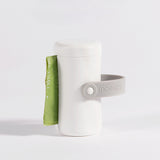
Pair it with the walk harness and a bungee cord, or get all of it, plus a clip-on poop bag holder, in the UFO Gen 3 Complete Walk Kit.
Free hands, calmer walks. Your coffee will thank you.
Written by the moestar team.